Thinking
The conceptual scaffolding underneath the project. Nine hypotheses the rest of the work sits on top of — some of them old and settled in my head, some still fresh. If you disagree with any of them, the rest of what I'm doing may not hold, so I'd genuinely like to hear about it.

1. The pipeline has one paid link, and it's the phone.
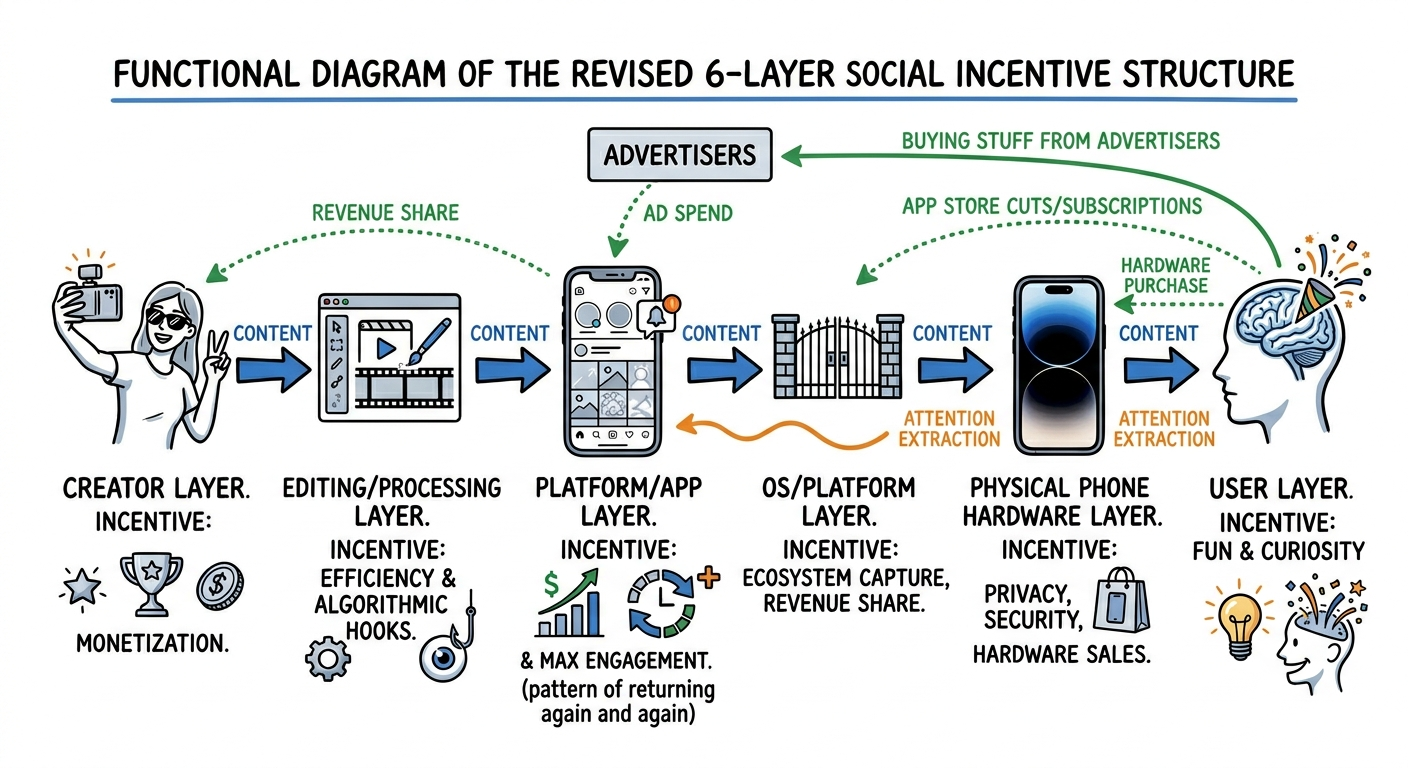
Content → platforms → ad networks → algorithms → display → you. Every link in that chain is either paid by advertisers or paid by attention. The one exception is the device in your hand. You bought it. That makes it the natural intervention point, and the only one where "work for the user" is compatible with the business model.
2. Restriction-based tools don't work because they recreate internal conflict.
Light Phone, Freedom, Forest, Screen Time — they all pit the part of the user that wants to scroll against the part that wants to stop. The user flip-flops. Restrict, resist, break down, binge. A phone that actually helps has to integrate those parts, not referee them.
3. Phone addiction is a closed-attention loop.
[illustration: the body while scrolling — parts asking for things]
Not superstimulus. Not bright colors. A person scrolling for eight hours is physically uncomfortable. The nervous system is asking for water, a walk, a call with a friend. Being able to ignore those signals for that long is the mechanism. Anything that reopens attention — including, interestingly, attention to the body — breaks the loop.
4. The market is held in place by a tacit agreement.
Google, Apple, Samsung all make more when you scroll. None of them has a strong incentive to defect first. But the equilibrium is fragile: the moment one manufacturer ships a phone that respects its users, the others have to follow or look bad. Someone is going to defect. I'd rather it be someone whose first principle is users.
5. Integration over division.
The opportunity is in interfaces that foster integration rather than division. The part of you that likes scrolling TikTok is fine — it doesn't need to be overruled by the part that wants to stop, it needs the parts to live together.
6. The bouncer and the assistant.
A lot of the intelligence we project onto a phone is in another layer, and the phone is simply doing what it's told. What people need is a savvier, sneakier, craftier bouncer phone — and also an assistant, something surfacing the three friends you've been meaning to text, the call you could make right now.
7. Layers, not locks.
[diagram: a perceptual layer sitting between the content pipeline and the eye]
The interventions I'm interested in aren't blocks, they're layers between you and the content. A picture frame around the feed, the way a painting in a museum has one. Parallax depth, so the screen feels a foot inside the device. Saturation that drains as the session goes on. The room behind the phone showing faintly through the camera. None of it asks you to choose between scrolling and not scrolling. It just makes a phone a little more like a window and a little less like a portal you fall into.
8. These are obvious opportunities, not shameful failures of self-control.
In retrospect, the current system is fairly unstable. Hundreds of millions of people spending thirty hours a week on stuff they don't especially enjoy was never going to last a hundred years — like the opium dens era, it'll be a sort of embarrassing thing that happened. Reading about the Wright Brothers, I keep thinking: heavier-than-air flight wasn't a secret, it was widely discussed, just stuck on the wrong models. The fact that no one has done this is nuts.
9. Beauty, not harshness.
You solve phone addiction with beauty rather than harshness. Most tools in this space tell the part of you that likes scrolling TikTok that it's bad and wrong and a child, and that part is fine — it just needs reminders that you have hands and agency and that there are sunsets. You don't have to solve anyone's emotional problems to build a less addictive phone. You just have to close the interestingness gap a little between the phone and everything else.
Diagrams, comics, and illustrations in development. This page will fill out as they're made.
Deep Research
Longer, reference-style documents generated with LLM deep-research tools, kept here for anyone who wants to dig in. They're not my voice — they're maps of the surrounding terrain, useful as context for the project.
-
Tier Explorer: So you want to do stuff Google doesn't expect with Android
→
An interactive companion to the deep research below. It lays out the layers you'd actually touch if you were forking Android — UI overlays, system services, communication standards, hardware — and at each tier surfaces what becomes possible, what breaks, and what it costs in GMS compatibility and economics. Meant as a navigable map of the tradeoff space.
-
Forking Android: Challenges and Tradeoffs
→
A systems analysis of the Android ecosystem — MADA, anti-fragmentation agreements, Play Integrity, RCS gatekeeping, and the BOM economics that make a minimalist phone expensive to build. Includes an appendix on CTS and the limits of UI overlays.
-
The Architecture of the Attention Economy
→
A financial map of the mobile ecosystem — the $20B Google–Apple search deal, Apple's 73.9% Services margin, Samsung's Customization Service, TikTok Shop mechanics, and what a 10% drop in engagement would actually cost the companies in position to build a better phone.